Can Fencing Help With College Admissions?
Can Fencing Help With College Admissions? A Parent's Guide
For many families, choosing a sport is about more than staying active. Parents want their children to build confidence, develop discipline, and discover interests that may shape their future. That leads to a question we often hear at ASER International Fencing Academy: Can fencing help with college admissions?
Yes, fencing can strengthen a college application. For some competitive athletes, it can also lead to conversations with college coaches and potential recruitment opportunities. But fencing never guarantees admission, and the value of the sport extends well beyond getting into a particular university.
How Does Fencing Help With College Applications?
Colleges may consider a student's activities outside the classroom alongside academic achievement. Years of fencing can demonstrate more than participation in a sport.
Commitment and time management: Regular practices, competitions, and school responsibilities teach athletes to plan ahead and work toward long-term goals.
Critical thinking: In an epee bout, fencers constantly assess distance, timing, and their opponent's intentions. They must make decisions quickly and adjust when a plan isn't working.
Resilience: Every athlete loses bouts. Learning to accept a disappointing result, reflect on mistakes, and return to practice is an important part of growing up.
Leadership: Experienced fencers can support younger teammates, set an example during training, and learn to take responsibility for their actions.
These qualities do not automatically improve an admissions decision. They do, however, give students meaningful experiences to discuss in essays, interviews, and extracurricular activity descriptions.
Can Fencing Help With Ivy League Admissions?
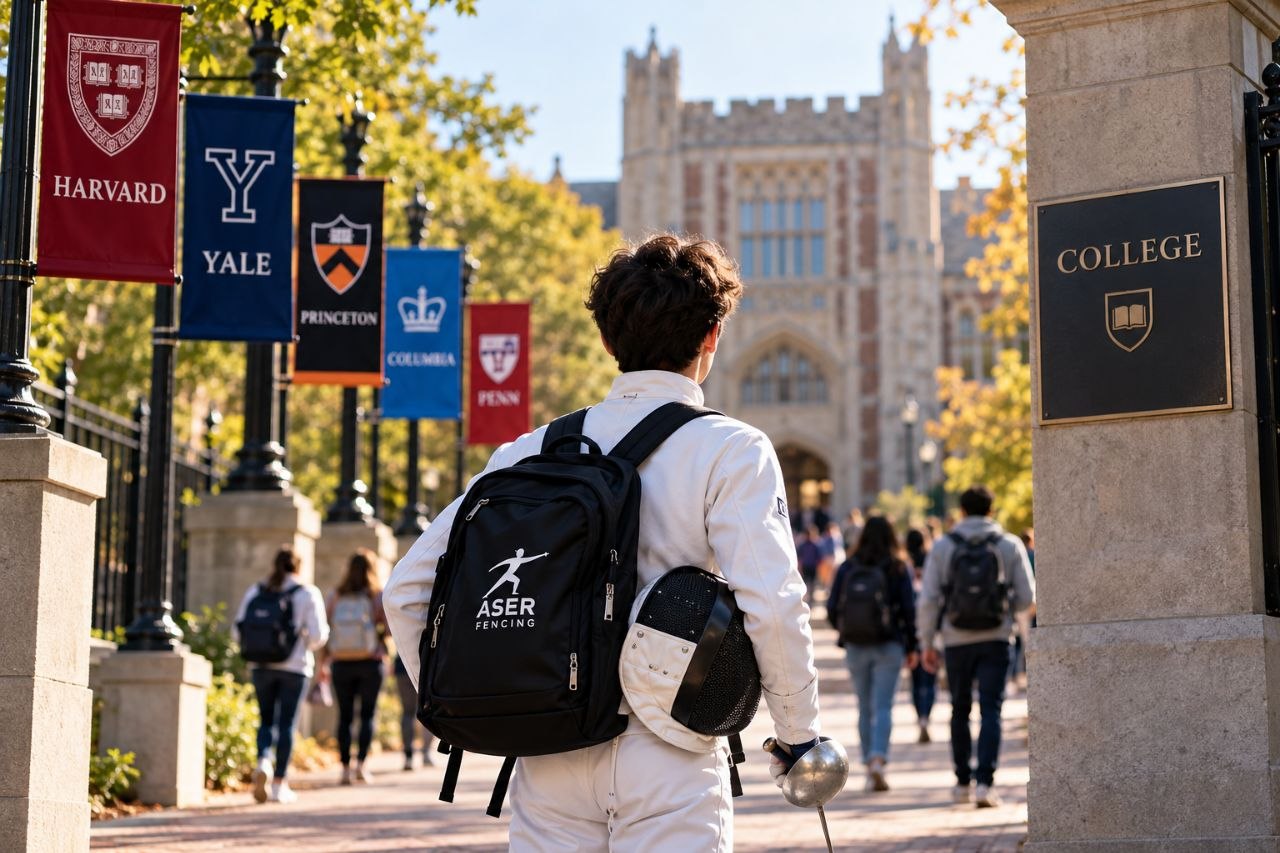
Harvard, Princeton, Yale, Columbia, and the University of Pennsylvania are among the Ivy League universities with varsity fencing programs. Strong competitive fencers may attract attention from college coaches, and some recruits may receive support through a school's athletic recruiting process.
Recruitment is selective. Coaches evaluate competitive results, athletic potential, academics, and team needs. A coach's interest or support does not guarantee acceptance; the university makes its own admissions decisions.
Students who are not recruited can still include fencing as a meaningful extracurricular activity. For many applicants, the most compelling part of their story is not a medal but the dedication and growth behind it.
Do You Have to Be a National Champion?
No. NCAA varsity fencing is highly competitive, particularly at selective universities, but it is not the only way to continue fencing in college. Many schools have club fencing programs that welcome students with different levels of experience.
A student can also benefit from years of fencing without joining a college team at all. The important question is what the athlete learned, accomplished, and contributed during that time.
Why Long-Term Development Matters
After years of coaching young athletes, I have learned that progress rarely follows a straight line. Some children improve quickly; others need more time to develop confidence, technique, and competitive maturity.
A medal at age 12 does not predict everything that will happen at 17. Likewise, an athlete who struggles early may grow into a very capable competitor. Consistency, motivation, and the quality of training matter more than chasing immediate results.
At ASER, our approach combines technical instruction, tactical development, physical conditioning, and individual attention. We want athletes to become better fencers, but we also want them to learn how to work through challenges and take ownership of their progress.
From the Fencing Strip to College: ASER Alumni
One of my favorite parts of coaching is seeing former students begin the next chapter of their lives. Over the years, athletes who trained with us have gone on to universities across the country. Their paths have been different, and each achievement belongs first to the student and their family.
Dylan Amolsch — University of Virginia
Dylan started fencing with us as a beginner, progressed to a B rating, and continued his education at UVA with an interest in Pre-Law.
Samantha Lu — Carnegie Mellon University
Samantha became a B-rated fencer and went on to Carnegie Mellon to study Computer Science and Music.
Hall Liam — College of William & Mary
Hall earned an A rating before continuing his education at William & Mary, studying Finance.
Trent Chemezov — Cleveland State University
Trent developed into a B-rated fencer and continued to Cleveland State, where he received a scholarship and pursued Pre-Law.
Bill Lam — University of Miami
Bill began training with us in 2019, earned a B rating, and went on to the University of Miami with an interest in Pre-Med.
Nicolas Espinal Dapic — College of William & Mary
Nicolas progressed to a C rating and continued his education at William & Mary, pursuing Pre-Med.
I am proud that fencing was part of these students' lives. Still, their college destinations should not be taken to mean that fencing secured their admission. Academic work, individual circumstances, and each university's decisions all matter.
What stays with me most is watching young people become more independent, persistent, and confident. Those are achievements worth celebrating regardless of where they attend college.
Should Parents Choose Fencing for College Admissions?
I encourage parents to start with a simpler question: Does my child enjoy fencing and want to keep learning?
When a child finds a sport they genuinely care about, the effort becomes meaningful in its own right. They learn to prepare, compete, lose, improve, and try again. If college recruitment becomes an option later, that is an additional opportunity—not the only reason to train.
Families interested in college fencing should keep academics a priority, research university programs carefully, and understand that recruiting requirements vary. We will explore the college fencing recruitment process in a separate guide.
Final Thoughts
Fencing can help students build a strong extracurricular record and, for some athletes, open a path toward collegiate recruitment. It cannot promise admission to an Ivy League university or any other college.
At ASER International Fencing Academy, our goal is to give young athletes the coaching, structure, and encouragement to develop their potential. Whether they pursue NCAA fencing or a completely different career, we hope the lessons they learn on the strip stay with them.
Try Fencing at ASER in Sterling, Virginia
ASER International Fencing Academy welcomes beginners and competitive fencers from Sterling, Ashburn, Herndon, Reston, and surrounding Northern Virginia communities. Our program is led by Dr. Saeid Serajian, Ph.D. in Neuromuscular Exercise Physiology and an experienced international fencing coach.
Book a free trial fencing class and discover what your child can achieve.