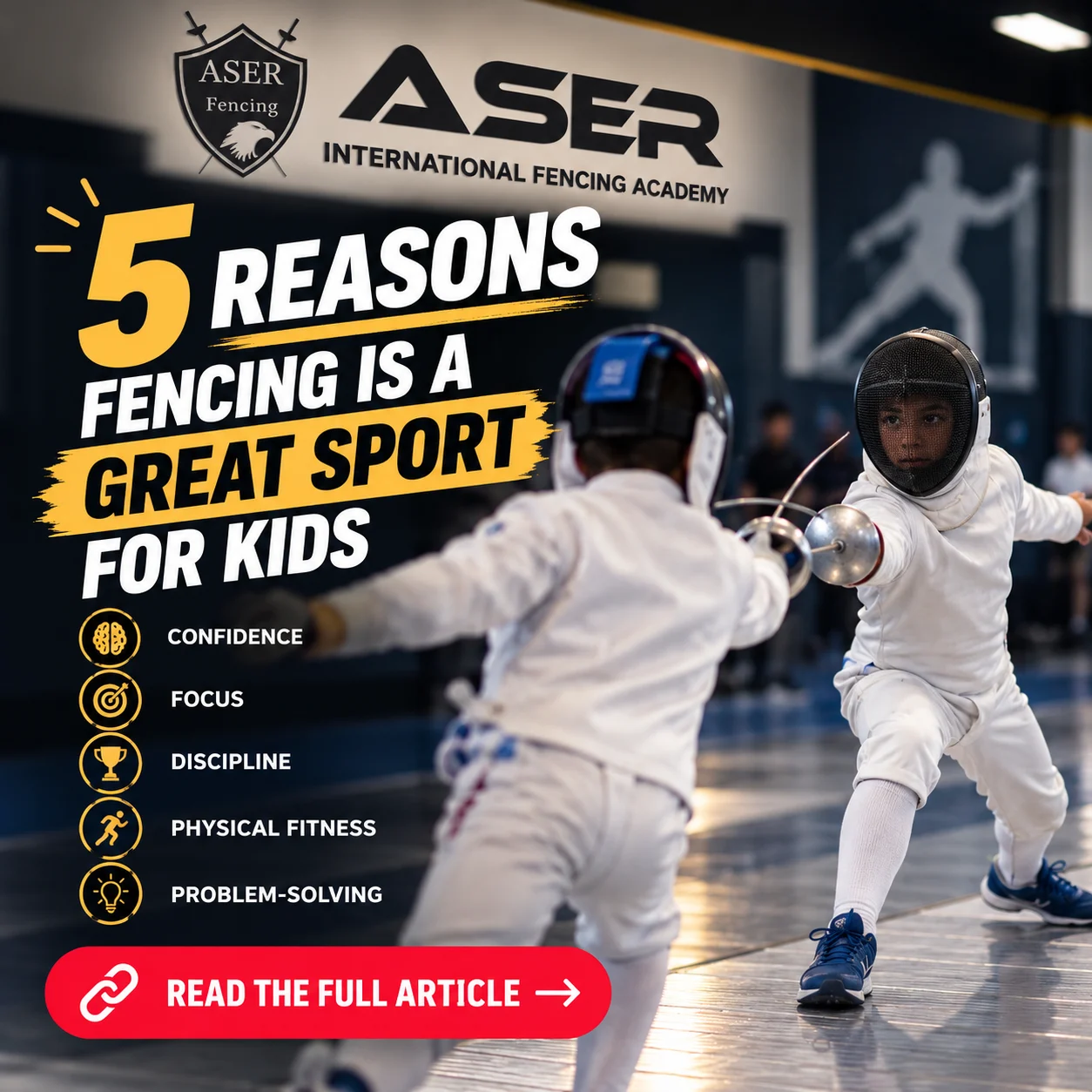
5 Reasons Fencing Is a Great Sport for Kids
5 Reasons Fencing Is a Great Sport for Kids
Choosing the right sport for your child is about more than keeping them active. The best sports help children grow physically, mentally, and emotionally while giving them something they genuinely enjoy.
Fencing offers a unique combination of all these benefits. Often described as “physical chess,” fencing requires athletes to move quickly, think strategically, make decisions under pressure, and continuously adapt to an opponent.
Here are five reasons fencing can be an excellent sport for children.
1. Fencing Develops Focus and Concentration
In fencing, a child cannot simply go through the motions.
Every moment requires attention. Fencers must watch their opponent, recognize distance and timing, anticipate an action, and decide how to respond—all within seconds.
This makes fencing an excellent activity for developing concentration.
Young fencers gradually learn how to block out distractions and stay focused on the task in front of them. As they progress, they also learn that losing concentration for even a moment can change the outcome of a bout.
That ability to focus can become valuable far beyond the fencing strip, including in school and other activities.
2. Fencing Builds Confidence
One of the most rewarding parts of coaching young athletes is watching their confidence grow.
A beginner may initially feel unsure simply holding a fencing weapon or facing an opponent. Over time, however, that same child learns how to move, attack, defend, make tactical decisions, and compete independently.
Every new skill becomes a small accomplishment.
Fencing also teaches children that confidence does not mean always winning. It means being willing to try, make mistakes, learn, and come back stronger.
For many children, especially those who may not immediately connect with traditional team sports, fencing can provide a completely different environment in which to discover their abilities.
3. Fencing Teaches Discipline and Patience
There are no shortcuts in fencing.
Improvement comes through repetition: practicing footwork, refining technique, learning distance, developing timing, and repeating actions until they become natural.
Children quickly discover that progress requires consistency.
At the same time, fencing teaches patience. A fencer cannot attack simply because they want to score. They must learn when to wait, when to prepare an action, and when the right opportunity appears.
These lessons—practice consistently, control your impulses, and trust the process—are valuable skills both in sports and in life.
4. Fencing Provides a Full-Body Physical Challenge
Fencing may look effortless when performed by experienced athletes, but it is an extremely dynamic sport.
Training can develop:
Coordination and balance
Speed and agility
Leg strength
Cardiovascular fitness
Reaction time
Body control
Fencing also requires athletes to coordinate their eyes, hands, and feet while changing direction and responding to an unpredictable opponent.
Because the activity constantly changes, children are not simply repeating the same movement. They are moving, reacting, thinking, and making decisions at the same time.
Most importantly, when children enjoy the activity, exercise stops feeling like something they “have to do.”
It becomes something they look forward to doing.
5. Fencing Develops Strategic Thinking and Problem-Solving
This may be the characteristic that makes fencing most unique.
Every opponent presents a different problem.
One opponent may be aggressive. Another may wait and counterattack. One may be faster, while another may use distance extremely well.
A fencer must recognize what is happening and adjust.
What is my opponent trying to do?
Why did my last action fail?
What should I change on the next touch?
Children learn that repeating the same strategy does not always produce a different result. They must observe, analyze, adapt, and try again.
That is why fencing is frequently compared to chess—except the decisions are being made while both competitors are moving at high speed.
More Than Winning Medals
Competition can be an exciting part of fencing, but medals are not the only measure of success.
For a young athlete, success may mean becoming more confident, learning to concentrate longer, handling a difficult loss maturely, solving a tactical problem independently, or simply discovering a sport they truly love.
And that last point may be the most important.
Children are much more likely to work hard at something when they genuinely enjoy doing it.
The goal should not simply be to find another activity for your child.
It should be to help them discover something that makes them excited to learn, practice, and improve.
Fencing might be that sport.
Let Your Child Experience Fencing
The best way to find out whether fencing is right for your child is to let them experience it.
At ASER International Fencing Academy in Sterling, Virginia, young athletes learn fencing in a structured environment designed to develop technical skills, physical abilities, tactical thinking, confidence, and a genuine love for the sport.
New students can experience our program through our Two-Week Free Trial.
No previous fencing experience is necessary.
Let your child pick up a sword, step onto the fencing strip, and discover what they can do.
ASER International Fencing Academy
Sterling, Virginia
Two-Week Free Trial Available